Sunday, November 3, 2019

Travel health or exploring Bulgarian medicine

These are our good sides...

We are middle-aged guys with baggage or, what the insurance industry and Congressional Republicans like to call 'pre-existing conditions'. We are reasonably healthy from day to day, but with hefty pill boxes and a few nagging complaints. We plan these trips anticipating good health- we maximize self-directed tourism, with lots of walking. I have arrived home from Europe the last two years fifteen pounds lighter as a result.

We coordinated our scrips to the last pill with the help of our friends at CVS and each of our doctors' offices. We opted to pour all six weeks of our European trip's meds to avoid traveling with a dozen or more pill bottles. The CVS app had every scrip recorded if anyone had a question. We were entering the EU through Amsterdam, a port of entry we know well. We couldn't imagine we would have a problem there. (We didn't.) After that, from the Netherlands to Bulgaria and back, we would be in the bosom of the European Union and its customs union. Now, as we are at our final stop in our itinerary, the meds, plus the basic medicine chest of poop pills,  pain pills and itch creams has completely worked. Yay.

But our string of unremarkable travel health days ended as we left Athens. On out last evening in Athens Mark complained of a twitch in his eye. The next day, as we waited in a stupidly long immigration queue in Sofia, Bulgaria, it became clear that something was wrong with Mark's face. The right side was beginning to sag. Right there, in the airport, I called our doctor in Albuquerque, describing what seemed like Bell's Palsy, the partial paralysis of the face along a facial nerve. 

An hour later we had checked into our Airbnb apartment. I made a 14 second video of Mark's face and sent it to a buddy back in Burque, a plastic surgeon. Probably Bell's Palsy, something viral, likely to run 7-10 days. Mark and I both were Googling away at the symptoms. It was likely Bell's Palsy, but the prognosis was uncertain and might be improved with prednisone. We went out for a walk that evening. I noticed a clinic a few blocks away. Our family doctor called back and wanted Mark to go to the ER to be evaluated for a stroke. As 'strokey' as he might have looked(his words), he didn't have any significant pain or other symptoms. After hanging up with her we decided to wait, then hit that clinic in the morning.

We aren't unfamiliar with facial paralysis at our house. Ever since I had brain surgery in 2005 I have dealt with a mild paralysis on the left side of my face. There was an acute phase, right after the surgery, when closing my left eye at all required surgical tape and an eye patch. We lived through those weeks together, so we knew we needed to take care of his eye.

Now we were in Sofia, Bulgaria, a place where we had never been. Everything is written in Cyrillic. In a great coincidence, Julian, our Amsterdam host, arrived in Sofia for meetings with a renowned group of HIV pharma nerds. Surely they knew Bulgarian doctors. We called Julian and he was on the charge.We went back to the clinic we had seen the night before. After initially saying that they had no openings, a very sweet woman took pity on us and said to come back at 1pm. Meanwhile, Julian had gotten the advice of a Bulgarian physician, and that we could get prednisone over-the-counter in any pharmacy. Self medicating with a cortico-steroid seemed like a last resort. 

We had to suck it up. The first of four precious days in Bulgaria was going to be spent exploring the health care delivery system. Ugh. We had a guided walking tour of Sofia planned for that afternoon. I reached out to our guide, and she graciously moved our tour to the next morning. We showed up at the clinic a little early then, after inspecting Mark's driver's license and his health insurance card, we were escorted upstairs. He first saw an opthamologist, a young woman with fluent English, who gave him a complete eye exam. She agreed that it was likely Bell's Palsy, but that Mark should see her colleague, a neurologist, down one floor in the clinic building. So down the stairs we went.

The neurologist was an older woman, likely trained in the Soviet days. She spoke no English but the clinic sent in an interpreter. She did a full evaluation for possible stroke. She came back with the Bell's Palsy diagnosis, a prednisone scrip and a bunch of other stuff. Three pharmacies later, we had the eye goops, the eye patches (night time use) and an analgesic that played nice with the corticosteroid. And she said it would likely get a little worse before it got better. She was right.

So we then went down to receive and pay the bill. For the exams by two specialists, mercifully under one roof, and a 90 minute set of medical encounters we paid the princely sum of... 108 lev/ $60. I paid cash and collected the receipts. I carry a large credit line credit card in case of something drastic, but I had this much Bulgarian currency in my wallet. 

Meanwhile, I was having mobility issues, both feet and knees. I had stomped around Amsterdam in my Wesco lace-ups for a day and a half. It all felt very virile but definitely was too much. We then spent six days climbing the hills of Athens. My pegs were hurting. When we got to Sofia we had a killer guest apartment, but at the top of a 100-step climb, a fifth floor walk-up. Lordy. We couldn't just pass by the apartment- it was a mountain climb.

We were a fine mess-Strokey McStroke-face and Limpy. Mark took to mimicking the Yips, a skit from Sesame Street, puppet aliens with floppy mouths.  Incessantly. We had to tailor our plans, but we did everything we wanted to do in Bulgaria. We took a few more taxis, but we still got around. We went to Plovdiv (more later), climbing a hill to get to the Roman amphitheater. We went slowly but walked the entire way. The rough cobbles of the old town there nearly killed me, but we walked all the way back to the station to take our bus back to Sofia. 

We planned to stroll Rome- such a great way to know a city- and stroll we did. My feet were improving but we had three long walking days, Tuesday thru Thursday. On Thursday I broke down and deciphered the Roman metro system to get our day started. A breath of sanity. And we took a taxi at the end of the day to avoid walking back from Trastevere in the rain. Oh, and pasta is not a good food for someone with Bell's Palsy.

We could have written this post earlier but we didn't want anyone worrying about us. We are now ensconced in the cozy home of our Belgian buddy. Mark is practically yip-less but still wearing an eye patch and goop to go to bed. We feel like we dealt with the situations well. Our vacation was not ruined- we just earned another set of stories.

Yup yup yup yup yup yup


It's Like Church but with Metal Detectors


It's Like Church but with Metal Detectors

St. Pete's

Our Airbnb was around the corner from St. Peter's dome.  It rises half the height of a football field and was designed by the woefully understated Michelangelo. Even notice big things are farther away than they appear?  Around the corner was a 20-minute walk.


Mic's Pieta

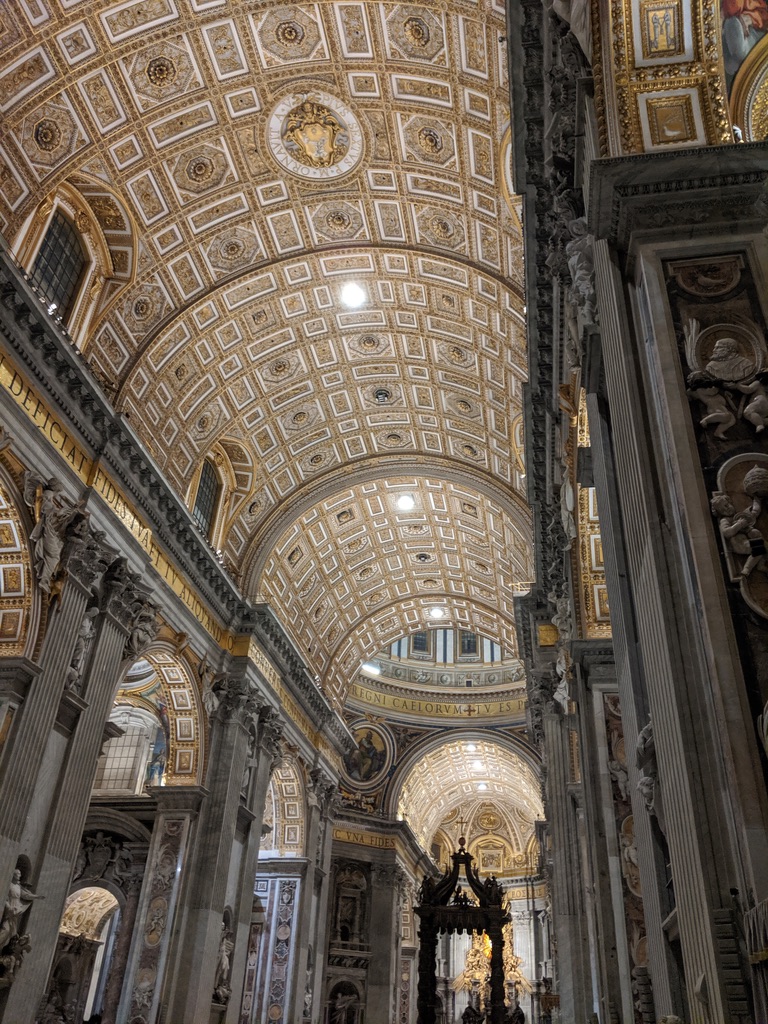
Our host asked us if we had been to Rome.  We said yes and he joked that nothing had changed.  Well, that's mostly true.  Saint Peter's Square was a complete zoo at midday.  The area near the Basilica was filled with seating and a good part of the square was a cattle queue leading to metal detectors. We figured it would take a few hours to get into the church.  If you had doubts about the power of the Vatican gift shop, you my friend, are incorrect.  Although we were in Rome, maybe later was on our minds more than pilgrimage and long pants.  We figured there had to be a way to see the Church as well bypass the crowds.  According to the Google, the crowds die down after 5:30 pm until the doors close at 7 pm.  We took a short nap and headed to the Square.  Sure enough, the lines were less than 10 minutes long—I didn't even have to take off my shoes to go through the metal detector!  The inside of the Church was also quieter. At capacity, St. Peter's can hold 60,000 standing screaming fans (though they tend to be more reserved).  This evening, it was a gentle stroll around the hanger without bumping into any camera phones.  There was still the occasional glamour-selfie here and there, but it was still possibly to avoid accidentally photobombing everyone's memories. (As an aside, what possesses people to make glamour-selfies—especially in a church?)

Imagine the Heating Bill?
We did notice one big change in the Basilica for the worse—you can no longer approach the altar.  There was a rail about 50 feet from the Bernini Altarpiece and baldachin. The Baldachin is that canopy over the throne or altar, silly!  Our audio tour pined on all the details of the stroll around the columns as we stood and watched from the cruel barrier.  Actually, the thing that bothered us most was that we were unable to see an incredible marble memento mori piece of the grim reaper grasping an hourglass.  It isn't the subject matter but rather the sublime carving. 

Old Photo of Cool Art

The end of the audio tour was a stroll to Michelangelo's first commission, The Pieta, a depiction of Mary cradling the dead body of Jesus.  After an attack in 1972, The Pieta was placed behind bulletproof glass.  Thanks a lot, Laszlo Toth, The Second Coming with a pick axe, my Tuchus.

Inside the Dome
On the five-minute walk of silence, I (Mark) decided to play Florence and the Machine's song, Between Two Lungs.  The song is about lovers embracing in a long kiss but it has always felt like a glorious allegory to death.  The act of holding onto life with your last breath before being released from bondage and suffering.  I smiled and slowly twirled around the church as I gazed at the glorious heavens painting several stories in the sky.  I'm certain God wants you to celebrate your visit.  I was just following orders.
Near the end of our visit, the ushers were herding the crowds towards the doors.  It was quiet and we could see a peaceful altar in the distance.  There is no better time to see Saint Peter's.  And don't forget, the gift shops are open late for all of your devotional needs…
The Swiss Guard


Water Water Everywhere


Water Water Everywhere


Why is water so hard in Europe?  Am I being pedantic, perseverating, or providing an exclusive on this elusive issue?  What you don’t know can ruin your day.  News at 11.

Let us wade into the problem easily.  If you are moving around Europe, the weather can vary greatly. Drizzle in the Benelux area of The Netherlands, Belgium, and Luxembourg is considered a 'nice' day.  Other parts of Europe may or may not get rain at certain times of the year.  Travelling between countries can complicate packing.
You arrive at your destination and decide to take a shower.  Did you remember (if necessary) to turn on the hot water tank or does the system use an 'on demand' system?  In many countries, there is no thermostat attached to the 'on demand' system.  Many showers have an on/off and a temperature knob. If you do not pay attention, the water may melt anything near the faucet including the marble sink or all your nerve endings.  If you were staying at our apartment in Rome, you might wonder if the kitchen even had hot water.  It never got warm.
It was a long flight and you need to use the bathroom.  Why isn't the toilet in the room with the shower?  It might be hiding in another closet.  Ok, how do you flush.  Do not panic.  There is a button or rope somewhere. Calm your breathing and explore.  You may be expected to use a common toilet brush after each use.  If you are in a fancy place, perhaps there will be a water fountain for your butt—the fabled bidet.  If you are in a horror film and the screams are coming from inside your head, you may find a shared garden hose and a squat toilet.  Nothing feels more Third World than hiking down your pants and placing your feet on the footplates for aim.  You wonder if something, perhaps a scarf or shirttail,  is oh, swaying in an unfortunate location between you and the floor.
Evil

Laundry.
  Perhaps I should stop here.  After five years of living in Europe, I still do not know how to use a washer in Europe. I remember coming into work after using my first washer and an American colleague came to the same conclusion—it takes six hours to use a washer between the manual and wash cycle.  All washers are small front-loaders which heat the water themselves.  Aside from diapers, who needs to wash clothes at 200F?  There are also not many buttons, knobs, or glyphs yet they don't seem to behave in any predictable manner. Forget to put something in the washer after the door locks?  You may be screwed for the next three loud hours or so.  Even after the cycle ends. The door unlocks at some random time of its choosing.
Water Goes in, Water Goes Out
My favorite Fanta, Cassis Flavored and a Bottle of Spa Red
Each country has a different kind of water.  Of course there is a new name for the agua, but did you want that with bubble, without bubbles, natural bubbles, or tap water?  The same brand of water in Holland (that is Belgian) is called 'red' for bubbles and 'blue' for still water reflecting the color of the labels.  This trick fails to work in Belgium, even though it is their brand called Spa.  How big is the bottle?  In the Benelux, a bottle of water is much smaller than a bottle of beer yet can still cost close to three dollars.
And finally, Where is the public toilet?  You are not in Kansas anymore, Toto.  Most places charge for bathrooms.  A little over a dollar seems to be common these days.  Don't tip all your coins in restaurants, you may have an emergency.  A horse, a horse, my kingdom for a horse! comes to mind.  Sometimes you will pay anything for a restroom—assuming you can find one.  There are now bathroom apps, but they cannot keep up with my incredibly-shrinking-capacity.
Majestic-When They Can't Get to You

Congratulations to Marc and Megan!

    Congratulations to Marc and Megan! In Celebration of your special day, help yourselves to a fancy dessert! Here are some ideas but feel ...